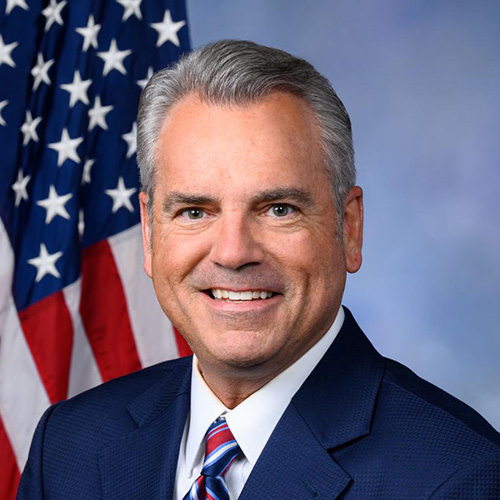
Today, Congressman Mark Alford (MO-04) issued the following statement after the House Appropriations Committee passed Commerce, Justice, Science, and related agencies (CJS) funding bill for fiscal year 2027.
“Another week, another government funding bill is passing out of the Appropriations Committee ahead of schedule and under budget,” said Congressman Alford. “This strong, responsible Commerce, Justice, and Science bill provides critical resources to keep our communities safe, support law enforcement on the front lines, as well as invest in American innovation and scientific leadership. By prioritizing public safety, combating the opioid epidemic, and bolstering our nation’s research and technology edge, this bill delivers for Missouri families and advances President Trump’s America First agenda. I look forward to seeing this legislation pass on the House floor.”
As a member of the House Appropriations Committee, Congressman Alford secured $5,390,000 in reasonable federal investments for the Fourth District to help turn the “Show Me State” into the “Grow Me State,” including:
- $4,200,000 for safe and reliable reactor operations at Mizzou’s Missouri University Research Reactor (MURR) in Columbia.
- $640,000 for critical communication equipment upgrades, including new communications helmets and radios, for the Webster County Sheriff’s office in Marshfield.
- $550,000 to provide Next Generation 911, upgraded emergency operator system communications equipment, for the Bates County Sheriff’s office in Butler.
Other Fourth District priorities secured by Congressman Alford in the FY27 CJS funding bill include:
- Increased funding to enhance weather forecasting, tracking, and notification, including increasing the National Weather Service’s total budget, additional funding for its National Mesonet Program, as well as the National Oceanic and Atmospheric Administration’s NextGEN gap filling radar technology, to ensure Missourians are protected during severe weather.
- Language to support the FBI’s efforts to relocate agents and other personnel from Washington, DC to the Kansas City field office.
- Establishing a pilot program under the Bureau of Prisons to develop a wastewater surveillance system to monitor infectious diseases and drug use, including fentanyl as well as other synthetic opioids and controlled substances.
- Preserved funding for the Regional Information Sharing Systems (RISS), which is a vital information sharing system used across law enforcement and emergency operators in Missouri, as well as the National Missing and Unidentified Persons System Program.
- Dedicated funding for the Department of Justice to modernize cybersecurity to combat attacks targeting law enforcement and legal infrastructure.
- Language to ensure the National Institute of Standards and Technology promotes the safe use of AI by small businesses as well as strengthens trust and adoption of federal AI systems.
###